
Historical Midwifery
Throughout history, midwives have been ever-present, often in the background, but always with us. There have been women in the community whom other women have turned to for support with women’s unique physical and emotional issues. Most people know the word, midwife ", an early English term for “with a woman”. The French word for midwife, “sage femme” (wise woman), dates back thousands of years, along with the Danish word, “Jordmor” (earth mother). The book of Exodus describes midwives who disobeyed the command of Pharaoh to kill all sons born to Hebrew mothers. When summoned by the king of Egypt for disobeying his command, the midwives explained that they never attended Hebrew births because the women were healthy and always gave birth before the midwives arrived.[1] In the seventeenth century, accounts of Native American childbirth practices were provided by European male explorers who described solitary, painless births without the presence of female supporters. Since men were not allowed to witness births at the time, these descriptions are probably inaccurate.
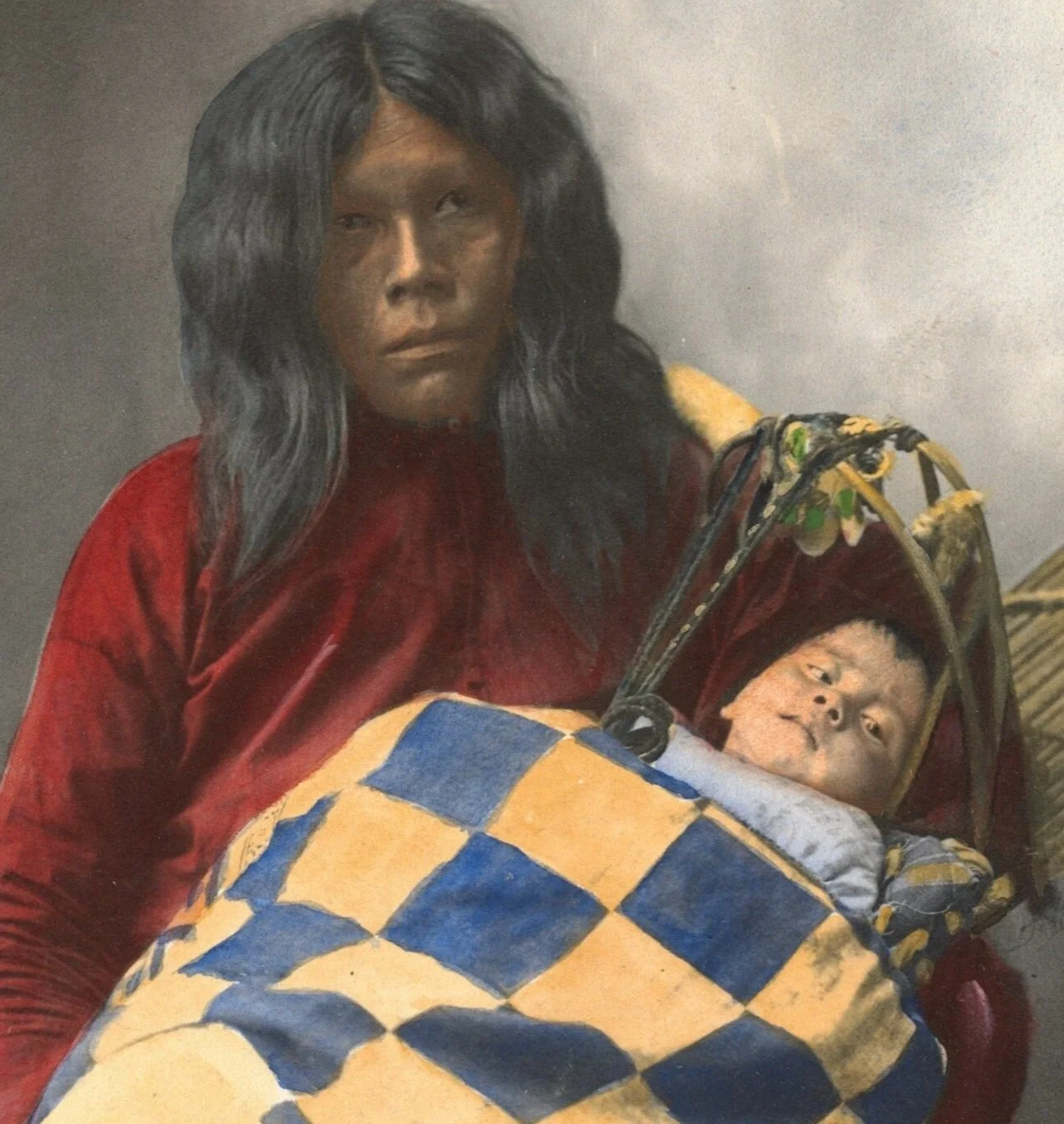
Midwifery/Birth Support existed in Native American Births.
Boston Public Library
Midwifery in Early America
Despite accounts of solitary birthing by Native American women, other reporting exists that midwives or close family members were usually involved.[2] Midwifery in Europe long predated the discovery of the New World, but when Europeans began migrating to the New World, midwives were part of this exodus. We know that childbirth in early America was attended by midwives. The majority of practitioners acquired their skills in the European countries from where they immigrated. From earliest historical accounts, childbirth was characterized as a social event, attended by women friends, neighbors, and relatives of the laboring woman. These birthing friends gathered in the appointed labor areas of the home, offering advice, moral support, comfort, and empathy while taking part in the deliveries of early American infants. Only during the most challenging and dysfunctional deliveries was a “physician” summoned to assist. The value of his contribution was physical strength and, occasionally, crude instrumentation to force a baby from its mother’s womb.[3]
European Men Interfere With Traditional Midwifery
In the 1750’s, European men with medical training were immigrating to America, bringing along instruments for a variety of medical interventions that might arise. The first Colonial medical school was established in 1765, and by 1810, midwifery was on the curriculum, with prospective midwives being taught at five American medical schools. Midwifery’s role in childbirth was recognized and well-accepted until attending birth became an economic transaction.[4] During this time, interference and instrumentation in childbirth became relatively common, culminating in the creation of a new medical specialty, “Obstetric Art.

Physicians in England and America Transform Childbirth
Physicians in England and America eventually began to transform childbirth from a family event into a lonely and male-dominated one. Coincident with the forming of this novel specialty, some early American doctors were satisfied to leave normal deliveries to midwives. A small number of interested physicians even offered training opportunities in obstetrick art to midwives seeking more knowledge.[5] Unfortunately, this interprofessional cooperation was short-lived, ceasing by 1820.
Renaissance Barber/Surgeons Forge Birthing Tools
Much earlier, during the Renaissance in Western Europe, barbers and surgeons formed an unexpected and lucrative alliance. Noting that the respective tools of their trades were eerily similar, these seemingly disparate professions conspired to exchange secrets, eventually merging to explore the mysterious, uncharted, and previously female-dominated universe of childbirth. It is necessary to explain that midwives of these times occasionally had to turn to these barber-surgeons when the events of a normal childbirth became desperately complicated (think: baby is stuck and must be removed by force). By 1588, barber-surgeons were inventing and perfecting metallic, mechanical tools for use in difficult labor and delivery situations. One particularly innovative and imaginative barber-surgeon, Peter Chamberlain, invented crude instrumentation to invade the maternal pelvis, later known as obstetrical forceps.[6]
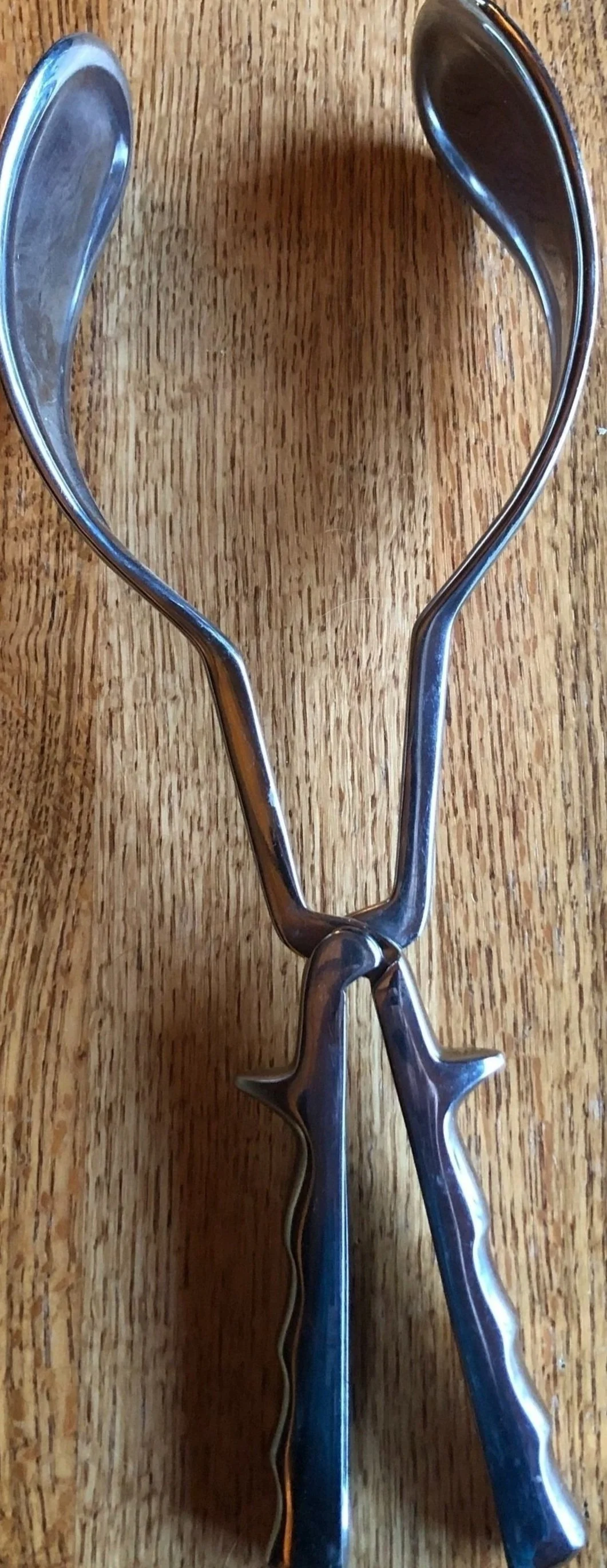
Contemporary version: McLean-Tucker-Luikart Obstetrical Forceps. Courtesy of: Michael L. Hall, MD
Forceps 101
While forceps have been modified over time, the primitive version was found to be expedient in extracting a baby, dead or alive, from the female pelvis. While shortening the birth process, crude forceps deliveries inevitably wreaked havoc on an unborn infant’s head, face, and buttocks, not to mention gross and irreparable damage to delicate maternal tissues. If mother or baby survived a traumatic forceps delivery, any surgical expertise of the barber-surgeon did not extend to repairing the likely perineal mutilation created during the process. Lacerations and jagged tearing of the female perineum, vagina, and rectum inevitably resulted in bladder or rectal-vaginal fistula formations. The unlucky recipients of traumatic forceps deliveries subsequently suffered persistent leakage of urine, stool, or both from their vaginas; injuries that would have been problematic for the remainder of their lives.
Chamberlains’ Lucrative Secret
Nonetheless, Chamberlain’s forceps were so successful, mechanically and financially, that other Chamberlain men joined in the metallic-birth business. Luckily, for the Chamberlain finances, forceps and their applied techniques were preserved as intellectual property, remaining a well-guarded family secret for three generations.
Although the Renaissance was a time of unparalleled discovery and invention, the development of maternal forceps introduced a time of unrestricted interference with female reproductive functioning, assaulting normal birth processes that only rarely required force, much less metallic intrusions into the female body.[7] At some point between the 17th and 18th centuries, other enterprising toolsmiths began to focus on the economic opportunities offered by forceps. In 1760’s America, the colonists’ circulation of fake news touted the growing popularity of medical men and their magical instruments. Concurrent with these exciting innovations, anything that resembled normal childbirth was condemned and advertised as a “perilous” event. Midwives were portrayed as outdated, unscientific, and incompetent. Early American media eventually succeeded in convincing women that safe childbearing required the superior skills of medical men and their birthing tools.[8
[1] Exodus 1:15-22
[2] Native American Customs of Childbirth. Teachinghistory.org/history-content/ask-a-historian/24097
[3] Suarez, SH. Midwifery is Not the Practice of Medicine. 1992. Yale Journal of Law and Feminism. 5(2):6. Available at: https://digitalcommons.law.yale.edu/yilf/Vol5/Iss2
[4] Supra note at 325.
[5] Suarez at 326.
[6] Bridsky, PL. Where Have All the Midwives Gone? 2008. JournalPerinatal Educ. 17(4): 48-51.
[7] Whether the Chamberlains’ instruments were quality-tested (on livestock, perhaps?) prior to use or just random, laboring women has not been recorded in historical materials. mmh
[8] Suarez at 326.
http://midwivesontrial.com