Myth of the Ordinary Midwife P
females.
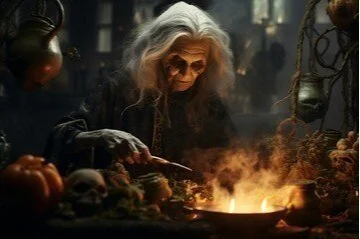
Disturbing representations of midwifery remain popular. They are mainstream, predictable, and frequently outrageous. Supporting the more popular and disturbing impressions are dramatic, unflattering portrayals of midwives in current entertainment media and popular fiction.
Unflattering Renditions of Midwives
With historical fiction, a midwife character may be portrayed as decrepit, toothless, and weirdly dressed; a wild-eyed, eccentric female who practices witchcraft, magic, Voodoo, or some version of scary spiritual practice. Without question, midwifery is magical, just not in these exaggerated contexts. [3]
Thematic Female Incompetence
When fictional portrayals of modern midwifery present a semblance of reality, the competence and independence of the midwife are usually diminished by a heroic male doctor who directly supervises her practice. The midwife character is featured as professionally lacking when compared to the wise and impressive male physician. Suppose the media production even identifies a character as a nurse-midwife, in addition to making coffee. In that case, her competencies are confined to herbal remedies, psychic healing, or aromatherapy —euphemistic nods to her role as a “fringy” healthcare alternative. [4]

Historical Hysteria
Hyperbolic midwifery imagery runs the gamut from gnarled grannies scuttling through the back alleys of medieval Europe to the drenched and weary assisting childbirth in the mud at Woodstock. Additional imagery has featured the midwife as a substance-dependent flower child, attending birth on the beach or in the attic of the Grateful Dead House. [5]
Where Would Midwives Be Without Witchcraft?
Of course, some form of “witchery” is never far removed from discussions of the history of midwives and their “craft”. Accounts from medieval Europe and the early American colonies have generously contributed to the association between midwives and witchcraft. In the history of colonial America, exaggerated perceptions circulated about the magical powers of women, midwives, pets, and livestock, some of which were extreme. [6]

Shaded By Our Colleagues
It is unfortunate that fabricated accounts of midwifery practice prevail and are disseminated by unexpected sources: the professions of nursing, medicine, public health, and law, as well as by random healthcare providers who practice alongside modern nurse-midwives on a daily basis. Whether from professional ignorance, arrogance, ordinary disdain, or historical prejudice, colleagues in the delivery of maternity care have been free to express negative opinions and circulate unkind impressions of modern midwives.
Creative Punishment For Witchy Midwives
Obviously, the practice of midwifery has been historically overburdened with nonsense, especially regarding punishment. From early America, reliable historical accounts from the Salem trials have failed to verify that midwives or witches were ever actually “burned at the stake” for practicing their profession. Death by hanging from the branches of trees or crushed by piles of large rocks? Yeah. Set on fire? Not in America. As entertaining and dramatic as these images are, they persist in the shadows, often tainting any realistic understanding of modern midwifery.
Even now, practicing midwives, from differing educational backgrounds and philosophies, continue to suffer various forms of professional “punishment” due to distorted public and professional perceptions. Modern midwives continue to be unfairly judged, diminished, forced from practice, and prevented from achieving the professional status that they deserve.
The Less-Than-Professional Midwifery Workplace
Most Certified Nurse-Midwives in America today work within hospitals and hospital-run clinics, which are physician-dominated. This stems from a long-standing medical hierarchy in this country and is reinforced by the title “Nurse” in the role of nurse-midwife.

unsplash-image The modern scary outfit
Although CNMs may have good reason to be proud of their nursing backgrounds, the title has supported a perception that, although nurse-midwives have obtained university post-graduate education and certified clinical expertise, they are rarely regarded, within the hospital hierarchy, as worthy or independent practitioners of maternal/infant health care.
These attitudes persist despite a well-defined scope of practice and joint statements of practice relations developed by the ACNM (American College of Nurse-Midwives) and ACOG (American College of Obstetricians and Gynecologists). In a hospital environment, nurse-midwives typically lack baseline professional regard. They have consistently been denied enhanced clinical status or even moderate respect.
When Can The Mid-Level Designation Be Burned At The Stake?
To complement the already problematic profile of CNMs/CMs, a pervasive and heinous descriptor has been attached to non-physician healthcare professionals practicing in corporate healthcare. Nurse-Midwives, Nurse Anesthetists, Nurse Practitioners, and every nurse in an “expanded role, including Physician Assistants (PAs), must now contend with the unfortunate title of Mid-level Provider.

While witnessing their professional identities being diminished by this label, advanced practice clinicians, aka “mid-levels”, are being hired, en masse, by healthcare institutions for economic reasons. Despite being labeled as mediocre, advanced practice clinicians are being lured into care situations as physician-extenders or doctor substitutes. While economically advantageous for the hospitals, advanced practice providers (APPs) are not paid in proportion to their responsibilities, nor are they properly identified or respected for their expertise. The mid-level designation is a stunning insult to independent clinicians who provide high-level care. See: “Mid-level Mortification”. ( http://www.midwivesontrial.com/articles/mid-level-mortification-n2yje-p3Akb-uYtmE)
Although still a persistent struggle, the practice of CNM/CM midwifery demands an understanding that it stands alone as a legitimate profession. Regarding CNMs/CMs as mid-anything or an unsavory derivation from nursing, medicine, or black magic perpetuates confusion and distrust in an academically founded and relevant model of care. [7] [8]
References/Footnotes/Commentary
1. McCool, WF et al. Closed Claims Analysis of Medical Malpractice Lawsuits Involving Midwives: Lessons Learned Regarding Safe Practices and the Avoidance of Litigation. J Midwifery and Women’s Health. July/August 2015. 60(4):437-444.
2. Attorneys should consider how negative consumer attitudes might affect legal cases involving CNMs. Given low consumer understanding of the profession, it might be easy to convince a panel of jurors that midwives have no business as maternity care professionals.

3. I concede the possible exception of the Call the Midwife series: BBC period drama about nurse-midwives working in the East End of London in the 1950s and 1960s.
4. Refer to seasons one and two of “Virgin River”: Netflix, adapted from the novels of Robyn Carr. In the Netflix series, the protagonist midwife began the first season as an independent Certified Nurse-Midwife who drives a red BMW, craves designer clothing, and 400-thread-count sheets (these details suggest early mitigation for the anticipated negative “midwife” credential of this character). Abruptly, in the following episodes, the midwife character is identified as a nurse-practitioner with an additional midwife “certificate” (like something she would have ordered online).
In Season One, the character did successfully manage an unexpected breech delivery in the middle of a hidden drug-ring encampment. But, by the second season, the presentation of the character as “midwife” was drastically toned down and eventually eliminated. It is likely that the juxtaposition of her classy, calm, and sophisticated character with her identity as a “midwife” was just too incongruous for the production team. Apparently, it was better to lose the weird midwife identity and, instead, present her as a heroic, post-grad, “Nurse Practitioner”, ex-emergency room nurse at LA County, and former nursing supervisor of a war zone Emergency Department.
In the series, the character earns a fair amount of credibility with the resume of an Emergency Department nurse. As a midwife, they never gave her a chance. See also, Netflix production, “Pieces of a Woman”. This story, while beautifully done, pokes another finger into the eye of midwifery credibility. In the story, a home-birth midwife is held responsible for a newborn's death and is sued for malpractice. The character is given a boring and depressed appearance and demeanor. She is also shown to panic during the respiratory arrest of the newborn she delivered—yet another negative representation of professional midwifery.

5. The counter-culture movement of the 1960s was born in the Haight-Ashbury neighborhood of San Francisco. While this imagery might be suspect in describing a colorful era of midwifery, media productions usually portray midwifery as either exaggerated or terrifying.
6. “In 1692, the Massachusetts Bay Colony executed 14 women, five men, and two dogs for Witchcraft. “No one was burned at the stake.” “No midwives died.” From The Witches: Salem, 1692 by Stacy Schiff, copyright © 2015. Reprinted by permission of Little, Brown & Company, an imprint of Hachette Book Group, Inc.
7. Blumenreich, GA. “Nursing is not the ladies’ auxiliary of the practice of medicine”. AANA ANNUAL MEETING, Chicago. AANA Journal. June 2004. 72(3): p. 173.
8. Certified Nurse-Midwives (CNMs) are prominent in these articles. However, Certified Midwife (CM) educational requirements, qualifications for practice, care standards, and legal liability burdens should be considered implicit in most discussions of CNMs.
https://www.midwivesontrial.com
© 2024 Martha Merrill-Hall JD MS CNM