

What Should We Do With Category 2?
In 2013, 18 authors (including a CNM, JD) developed an algorithm for the management of Category II fetal heart tracings. Acknowledging that there had never been a standard hypothesis to test dealing with interpretation and management of abnormal patterns, sixteen physicians, a nurse, and a midwife/JD, developed a standard approach for dealing with Category II.

In 2008, a Eunice Kennedy Shriver National Institute of Child Health and Human Development (NICHD) consensus panel proposed a uniform terminology system in which FHR patterns were classified as categories I, II, or III, based on the presence or absence of predefined FHR features. Once universally adopted in clinical practice, it was expected that the proposed definitions could serve as a first step for the development of a uniform standard of care in the interpretation and management of these patterns.1
What Has ACOG Done For You, Lately?
Subsequent recommendations had previously been developed by the American Congress of Obstetricians and Gynecologists. (ACOG)* for the management of Category I (normal) and Category III (pathologically abnormal) FHR patterns. The AJOG consensus recognized that the ACOG recommendations, while useful, were without significant value because greater than 80% of fetuses in labor display FHR patterns that fall into Category II, "patterns for which no ACOG management recommendations exist.2 To this day, ACOG has not made any recommendations for management of Cat II. The best they have done is to classify Cat II tracings as "indeterminate", meaning what? Not being able to say exactly what something is? Not helpful, practically or legally.

* The American "Congress" of OB/GYN was a name change during a time when ACOG was dabbling in political and legal advocacy. After a period of harsh criticism from peers and members, the group returned to OB/GYN business and became the American "College" once again.
Brain-Injured Baby Litigation
Lawsuits filed on behalf of infants (and older children) who have been permanently damaged from hypoxic ischemic encephalopathy consistently claim failures to recognize and manage potentially lethal FHR patterns in labor. These types of litigation persist and are successful. And despite a lack of scientific evidence that would support claims based on single FHR patterns. It has yet to be definitively proven that intervention actually prevents cerebral palsy. However, these claims are filed every day, and millions of dollars are awarded to these young plaintiffs at trial. Until the Clark publication, there has never been a standard hypothesis to test "dealing with interpretation and management of abnormal patterns. These authors in this study determined the necessity to finally address Category II and its management. The results are published in their paper: Intrapartum management of category II fetal heart rate tracings: towards standardization of care.

Rather than summarizing the article, I appeal to all CNM/CMs in hospital practice to print and read this paper in its entirety. The management algorithm is presented on page 90, under Figure 1. It should be cut out, laminated, and kept with you during labor management and FHR interpretation. Likewise, the table on page 9 outlines Cat II management and provides clarifications on using the algorithm. In this case, ACOG has failed to support clinicians, women, and infants by dismissing Category II tracings as indeterminate, suggesting that they can persist for undefined periods. Unacceptable. If I can make one specific recommendation to keep you out of our nation's courtrooms, it is for the information and guidelines provided in this publication. If you have already read this paper, read it again and make laminated cutouts. If you are not familiar with it, please become so!
Cat II Can Hurt You
Illustrated Verdict, Inc. mod-04-case42
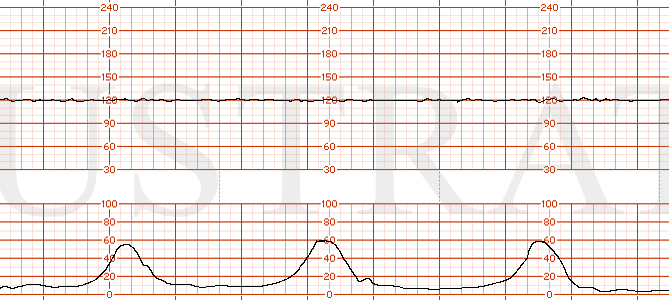
At the expense of over-simplification, internalizing the proposed algorithm can be as simple as this: Once having identified a Cat II tracing, if you cannot improve significant decelerations (greater than or equal to 50% of contractions over a period of 30 minutes (or an hour per the algorithm), you must consult with your collaborator and make a decision regarding delivery. Additional indications might include wandering baselines and minimal to absent variability. Remember, at least 80% of babies in labor will display Cat II patterns. That does not mean they should be considered normal. Cat II tracings can cause harm. If you cannot fix them within 30 minutes, they are not benign. They cannot be watched for hours on end. If you are unable to mitigate them, plans for expedient management must be coordinated with a physician back-up. In addition, good notes in the record are everything. Document with precision and care. You may be very glad, one day, that you did.
1. Intrapartum management of category II fetal heart rate tracings: towards standardization of care. American Journal of Obstetrics & Gynecology. Steven L. Clark, MD; Michael P. Nageotte, MD; Thomas J. Garite, MD; Roger K. Freeman, MD; David A. Miller, MD; Kathleen R. Simpson, RN, PhD; Michael A. Belfort, MD, PhD.; Gary A. Dildy, MD; Julian T. Parer, MD;Richard L. Berkowitz, MD; Mary D'Alton, MD; Dwight J.Rouse, MD; Larry C. Gilstrap, MD; Anthony M. Vintzileos, MD; J. Peter van Dorsten, MD; Frank H. Boehm, MD; Lisa A. Miller, CNM,JD; Gary V. Hankins, MD
2. Ibid. p.90
https://www.midwivesontrial.com